
Interested in learning more about one of the games below?
Pai Gow Poker: Slow the pace but keep winning
Just a few years ago Pai Gow Poker was a simple, slow game that was a nice distraction from the speed of blackjack. It took a long time to set your hand and resolve the bets, especially when other players were at the table. The rules were relatively simple: you are dealt 7 cards and need to make two poker hands – one with two cards and one with five cards. The deck is a standard 52 card deck with one joker that can be used as an ace or fill in any card to complete a straight or a flush. The hand with five cards needs to be a stronger hand than the two-card hand. In order to win the bet, you need to win both hands. If the dealer wins both hands you lose. If you win one hand but lose the other, the bet is a push. If a player hand ties with the dealer (which is more common than you would think, especially on the 2-card hand), the dealer wins the tie unless the player “banks” (which is discussed below). Since the advantage to dealer is minimal and can be neutralized by the player banking as often as allowed, the house edge is established by paying a 5% commission on winning hands. While the rules were simple, there were some complicated strategy decisions on the best way to set your hands. Now, unfortunately, everything has changed.
There are so many rule variations for the game it is impossible to list them, and some casinos have multiple versions of the game to offer. The trend started when casinos tried to implement rule variations that disadvantaged the player in exchange for the elimination of the 5% commission. This simplified the payout out procedure, and it made the game much quicker. The result, however, is that it changed the purity of the game and the way it is played.
The most common changes were eliminating the option of the player to “bank” (discussed below) and taking away winning hands from the player and replacing them with pushes. For example, when the dealer or the player cannot make a 5-card hand with a pair or better, it is called a pai gow. Obviously, the player hopes for the dealer to get a pai gow. The odds of the player winning substantially increase if the dealer has a pai gow, although it is far from guaranteed as the player may have a worse pai gow. To eliminate the commission, some casinos make hands where the dealer has a queen-high pai gow an automatic push for the player instead of a win. This is a substantial detriment to the player as a dealer with a queen-high pai gow is usually a win for the player.
Now we are seeing “face up” pai gow where the dealer sets its hand first before the player looks at his or her cards. This means the player can advantageously set his or her hand to win or push a hand that the player otherwise would have lost if the hand would have been set before seeing the dealer’s cards. However, “face up” pai gow does not allow the player to “bank” (discussed below) – thereby giving the dealer wins on all tie hands. The dealer also pushes, instead of loses, hands where the dealer has an ace-high pai gow. This give the house a significant advantage. We have seen “face up” pai gow at MGM Grand, right next to the regular pai gow table. While we would expect “face up” pai gow to be a significant advantage to the player, we found that it was not. The loss of banking and not winning dealer ace-high pai gow hands hurt us a player much more than the gain we realized from being able to set our hands after seeing the dealer’s cards. Our advice is to only play “face up” pai gow, if you typically are a player that does not bank.
Banking. The first rule of a serious pai gow player who wants to maximize winning is to bank whenever possible. Assuming standard pai gow table rules, the players can bank every other hand. However, if there are multiple players at the table who want to bank, you have to rotate the banking option among them. Moreover, you cannot bet more on a bank hand than you bet on the immediately prior hand (some casinos, allow for you to bank 10% more than your prior bet). Complicating his further, some casinos allow a “community bank” whereby all the players can pool their money and bank one hand together against the dealer. We last saw this at the Bellagio, but this is not a consistent rule across all MGM properties. If the player is the banker for a hand, that player’s hand goes against the dealer’s hand to determine if the player’s hand wins against the casino. The banking player’s hand then replaces the casino’s hand to go against any other players at the table. So a banking player needs to take the action of all the other players at the table. This can result in greater wins, but also greater losses. Large betting players use this power to prevent other players from banking and taking away the large player’s opportunity to bank every other hand. For example, if a large betting player is betting $1,000 a hand, a player that is betting $25 a hand will not want to assume the risk of going against player’s $1,000 bet and effectively making the small player’s bet $1,025. Large players avoid the problem of the players having to share the banking opportunity by either: (1) not playing with other players; (2) scaring off small betters from banking by making large bets; (3) sitting out hands where another player is banking; (4) participating in a community bank, if allowed by the casino; or (5) agreeing with the other banking player to split the banking bet. The bottom line is to take the banking opportunity whenever possible.
Side bets. Side bets are a significant part of pai gow poker. Since the game goes slow and does not provide a huge advantage to the casino, side bets were created to give the casino more action. The typical side bet is the “envy” bet where you are betting you will be able to make a three of a kind hand or better. If you do, there is a pay table. The pay table varies substantially by casino. Some pay tables consider both hands (for example, a full house five-card hand plus a two-card pair). Some include certain seven card hands (for example, the seven-card straight flush may be the best pay out). Some casinos (such as the Detroit casinos) have a progressive jackpot with a fixed amount of bet ($5). Some casinos allow you to vary your bets, but let you participate to small degree in another player’s big win by making at least an “envy” bet in the amount of $5. As with blackjack, these side bets are bad bets. However, we certainly play the $5 bet if there is a large progressive, and we have one over $34,000 on one of these $5 bets [photo]. We usually also make the $5 bet even on the pay tables without a progressive out of fear of hitting a big hand and not making the bet. If we were trying to maximize our odds, we would not do this. But we are also trying to have fun, so we make the bet (but keep it small).
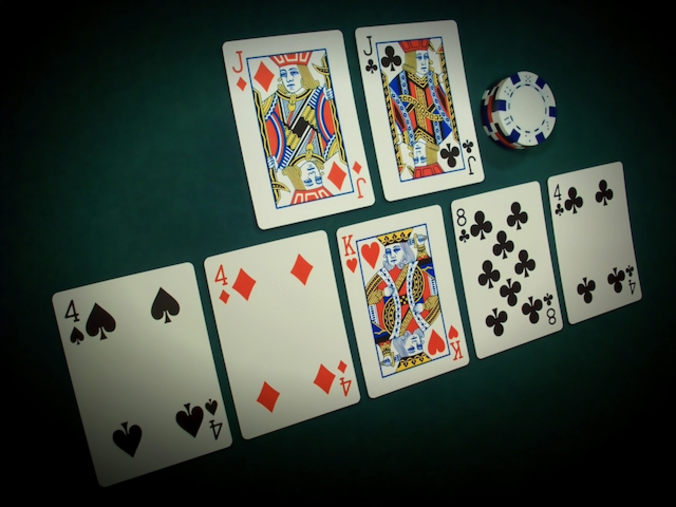
Strategy. The strategy for pai gow seems simple, but it can actually be quite complicated. This is part of the charm of the game. The decision on how to set you hand is usually easy as there is a clear play. As hand get more complicated with multiple pairs, flushes or straights, full houses, and high kickers, it makes some decisions difficult with no right answer. For example, if you have a paid of 8s, a pair of 4s and an ace, king and 9, how do you play your hand? You can split the pairs keeping the 8s in the five-card hand and put the fours in the two-card hand. Or you can keep the pairs together in the bottom hand and put the ace and king in the top hand. As with blackjack, the dealer does not have discretion on how to play its hand. It must set its hand according to “house ways.” What is maddening is that each casino has a different “house ways” on how to set its hands. Some will split the pairs in this instance because you have the ace kicker. Some casinos have house ways rules about splitting pairs if you do not have a pair with jacks or higher. While you think there should be a consistent way for casinos to play their hands, there is not. There are not even consistent rules about how hands are valued. For example, if you have a straight with Ace, two, three, four, five, some casinos value this as the lowest possible straight while others view the Ace as high making it the second highest possible straight.
Because this is so confusing, you can ask the dealer’s advice on how to set your hand. You are permitted to show the dealer your cards and the dealer will tell you the “house ways” for setting the hand. You are not required to do what the dealer advises, but at least you know how the casino will set it. Since the casino typically sets its hands to try to win both bets, you will have a good sense of how to set your hand. You may choose to vary the way you set your hand based on whether you want to try to win both hands or simply assure yourself at least a push by making one very strong hand. An example of this is a hand with three aces. The “house ways” is to split the aces by keeping two of them in the five-card hand and putting one in the two-card hand. This weakens the five-card hand to simply a pair (making it susceptible to losing to two pair), but it strengthens the two-card hand by having ace high. The alternative is to keep the three aces together making the five-card hand more powerful. The most common difficult decisions involve whether to split pairs or keep them together. The “house ways” is a guide, but ultimately the decision in yours as the player.
It is impossible to provide you the best strategy without knowing the “house ways” for the casino you are playing against. Also, assuming you do not want to vary your strategy based on the amount of your bet, we are providing you only the most basic strategy possible to give you the basic parameters to understand the game. This is a simplified version of basic strategy so it can be remembered. We urge you to take advantage of our services if you want to raise your game to the best possible odds.
If you are dealt a pai gow (not even a pair), the strategy is easy. Place the highest value card in your five-card hand and next two highest value cards in your two-card hand.
If you are dealt only one pair, the strategy is again easy. Place the pair in your five-card hand, and the two highest of the remaining cards in your two-card hand.
If you have two pair, split the pairs with the higher pair in the 5-card hand unless: (a) none of the pairs is jacks or better; or (b) you have an Ace to go with the two pair that you can play in the two-card hand.
- If you have three pairs, put the highest pair in the two-card hand.
- If you just have three of a kind, keep the three of a kind in the five-card hand and play the two highest kickers in the 2-card hand. This applies unless you have three aces. If you have three aces, play one of the aces and next highest kicker in the 2-card hand.
- If you have two three of a kind, break up the higher three of a kind by putting two of the three (a pair) in the two-card hand.
- If you have a full house, play the three of a kind in the 5-card hand and the pair in the 2-card hand regardless if kickers. If you also have a pair, play full house in the 5-card hand and put the highest pair in the 2-card hand.
- If you have four of a kind, split into two pairs if the four of a kind is jacks or higher regardless of the kicker. If nines or tens, keep them together if you have an ace kicker – otherwise split. If 7s or 8s keep together with an ace or King kicker that can be played in the 2 card-hand – otherwise split. If 5s or 6s keep together if ace, King or queen kicker – otherwise split. If 2s, 3s, or 4s, never split. If you also have a pair, keep the four of a kind in the 5-card hand and put the other pair in the 2-card hand. If you also have three of a kind, make the best 2-card hand possible leaving either four of kind or three of kind in the 5-card hand.
- If you can make a straight and a flush, play the one that gives you the highest two-card hand.
- If you can only make a straight OR a flush, play the straight or flush in a way that also gives you the highest possible 2-card hand while maintaining the straight or flush in the 5-card hand.
- If you have as straight OR a flush that has a pair using one of the cards in the pair to complete the straight or flush, play pair in the 5-card hand and break up the straight or flush only if the pair is 9s, 10s, jacks or queens AND you can put ace-king in the 2-card hand. Otherwise, play the straight or flush while also making the strongest 2-card hand possible.
- If you have a straight OR a flush, but you can also have 2-pair if you destroy the straight or flush, then destroy the flush and split the pairs with the higher pair in the 5-card hand unless: (a) none of the pairs is jacks or better; or (b) you have an Ace to go with the two pair that you can play in the two-card hand. Never play the straight or the flush.
- If you have a straight or a flush AND also a stand-alone pair, play the straight or flush and put the stand-alone pair in the two-card hand.
- If you have a straight or a flush AND three of kind, play the straight or the flush while also making the 2-card hand as strong as possible.
- If you have a straight or a flush but you have a full house that destroys the straight or the flush, play the pair in the 2-card hand and the three of a kind in the 5-card hand.
- If you have a straight or a flush but you also have 4 of a kind, put two aces in the 2-card hand. This hand is only possible by using a wild-card.
- If you have five aces, put two of them in the 2-card hand. This hand is only possible by using a wild-card.
Again, pai-gow can be a very fun game, but there are clear ways to maximize the odds. You must take advantage of banking whenever possible. It pays to go with someone who know the game and betting strategy to teach you. You should take advantage of our services when learning this game.
Advice by Topic
See our casino Reviews and give us your review for any casino in USA or Canada.
See our casino Reviews and give us your review for any casino in USA or Canada.